June 2025
Presenting Thinking Hats at IIA KERALA Chapter State Convention – KALAASHAM 2025

Design practice often unfolds quietly. It lives in drawings, site visits, long conversations with clients, and the slow shaping of land over time. Rarely does it pause long enough for reflection.
In June 2025, such a pause came for our studio when Thinking Hats Landscape Architecture Studio was invited to participate in the exhibition ‘100 Architectural Practices in Kerala’ at the IIA Kerala Chapter State Convention — KALAASHAM 2025. The exhibition brought together a curated group of practices from across the state, offering a snapshot of contemporary architectural thinking in Kerala. For us, it was both a moment of recognition and an opportunity to reflect on what defines our work.
An Invitation to Represent the Studio
Thinking Hats was nominated as one of 100 architectural practices across Kerala to be featured in the exhibition. The event, hosted by the Indian Institute of Architects (IIA) Thrissur Centre, took place over two days at Thrissur. KALAASHAM brought together more than 500 architects, students, and design professionals, creating a lively environment of exhibitions, panel discussions, workshops, and informal exchanges.
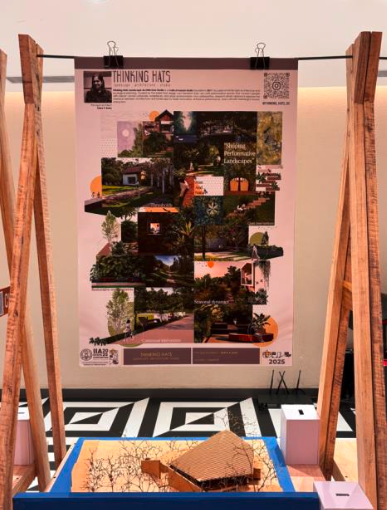
Each participating practice was asked to present its work on a single A1 sheet. Rather than a conventional portfolio, the sheet was meant to communicate the identity of the studio: its philosophy, one representative project, and visual glimpses of other works.
Distilling a Practice into One Sheet
Condensing years of work into a single sheet can be surprisingly difficult. It requires stepping back and asking a simple but essential question: What truly defines the practice?
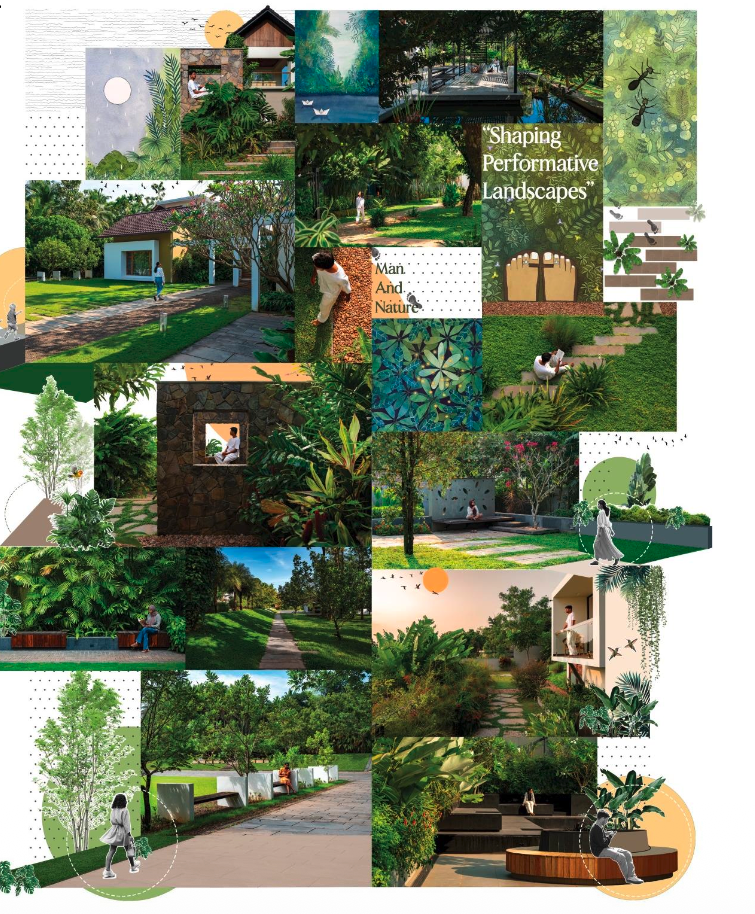
Founded in 2017 and based in Calicut, Thinking Hats works at the intersection of landscape architecture and ecological planning. Our projects span campuses, recreational landscapes, residential landscapes, and urban environments. Across these different contexts, the intention remains consistent: to create landscapes that do more than beautify space.
We see landscapes as performative systems — places that support ecological processes, respond to climate, and create meaningful human experiences.
Instead of presenting projects individually, the exhibition sheet organized our work through a set of recurring ideas: Sculpted topographies, Seasonal dynamics, Quiet interventions, Restorative environments, Thresholds, Contextual interventions.
Experiencing the Collective Exhibition
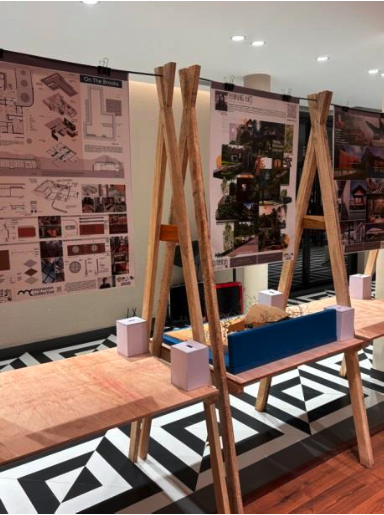
Walking through the exhibition was like moving through a cross-section of Kerala’s architectural landscape. One hundred boards stood side by side, each offering a condensed narrative of a practice. The diversity of approaches made the exhibition both informative and inspiring. Within this broader field, it felt meaningful to see landscape architecture represented as part of the conversation.
Looking Ahead
Participating in the exhibition was not simply about showcasing work. It was also a reminder that architecture and landscape evolve through shared conversations and collective learning.
For Thinking Hats, the experience reaffirmed our commitment to exploring landscapes as living systems — spaces where ecology, architecture, and human experience intersect.